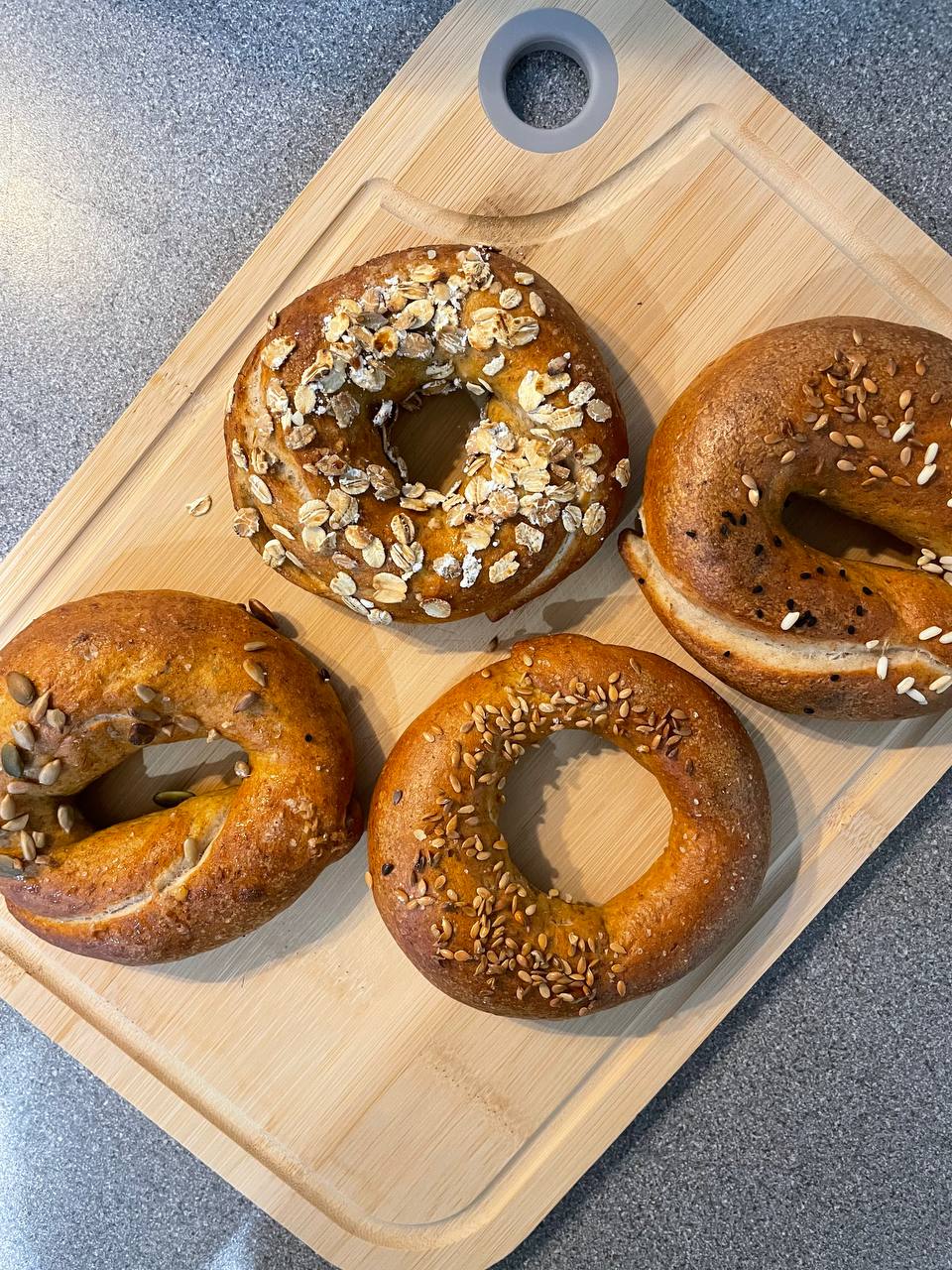
A few weeks ago, I wrote with trepidation that I’m getting back into sourdough baking. I’m happy to announce that I’m back at it, and getting better at a much faster rate than I was expecting!
Dusty Springfelt1 has helped me bake exceptional bagels (seriously: I’d take these over any that you can buy outside. Open to recommendations though).
Instructions
Recipe
I used a recipe from the e5 Bakehouse as the base, but modified it since theirs uses a combination of sourdough and commercial yeast. I was determined to just use sourdough.
- 100 g leaven (Theirs calls for 60 g leaven)
- 115 g water (Theirs calls for 135 g leaven. I reduced by 20 g to account for the increased liquid from the leaven)
- 0 g yeast (Theirs calls for 2 g fresh yeast, or 1 g dry yeast)
- 200 g strong white flour, 50 g wholemeal flour (Theirs calls for 270 g strong white flour. I reduced by 20 to account for the wheat from the leaven. I had to add wholemeal as I ran out of white flour…!)
- 12 g honey (Theirs calls for 12 g sugar)
- 5 g salt
Starter
I made my own starter by starting with a spelt base. I find that using a wheat base, particularly if white, leads to inconsistent growth of the starter2. After around 4 days of feeding, I had some good bubbles going on, at which point I decided to start feeding with strong white bread flour.
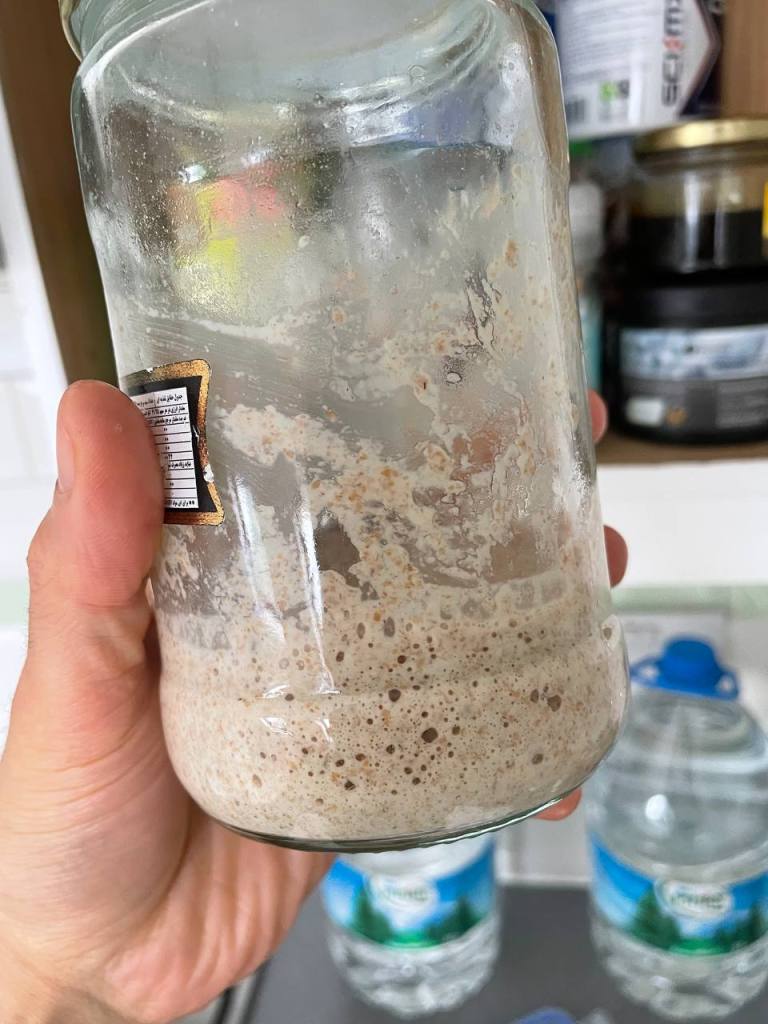
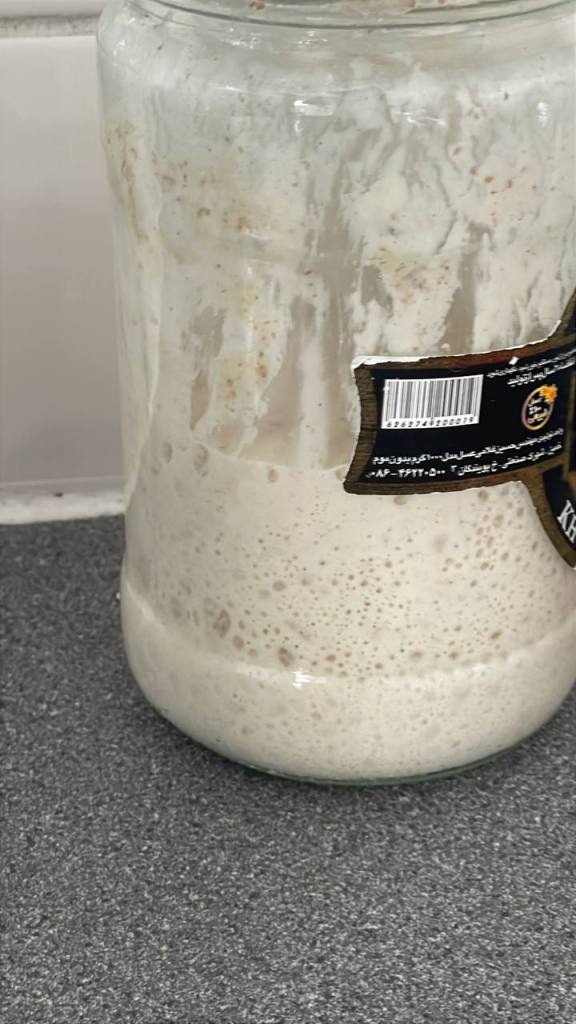
Unlike with my previous attempt at doing this, where I had very little growth, the wheat starter proofed to be very healthy, rising quite substantially towards the middle of every feed (around the 12 hour mark, though sometimes much earlier, e.g. after only 8 hours).
The morning before baking, I fed my starter the normal amount, and I made sure to monitor its rise. As soon as it doubled in size, I decided to put it in the fridge to slow the fermentation until I was ready to bake3.
Step by Step Instructions
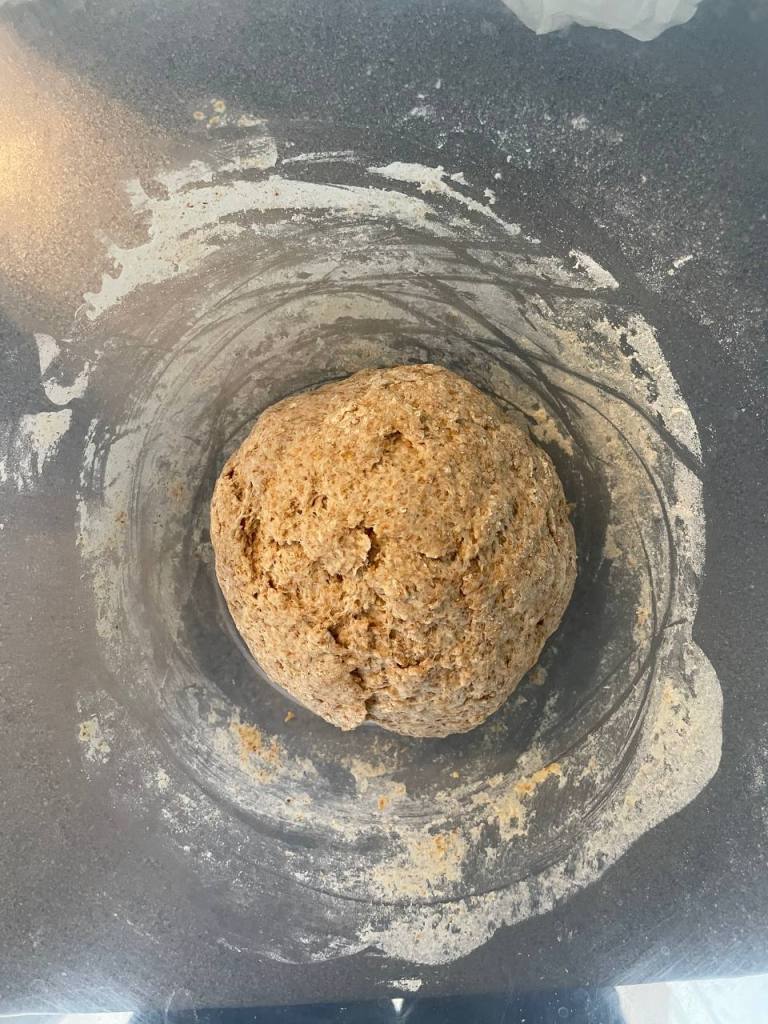
- Dissolve the leaven and honey in the water, and in a separate bowl mix the salt and flour. Add the dry ingredients to the water and mix everything together. Keep kneading until you arrive at a smooth through with all the flour absorbed into it. This will take some time, as the bagel dough is fairly dry (low hydration). While looking at all the bits of wet flour that are handing to the side you may fret and think that something is going majorly wrong… but trust yourself, and the strength in your hands and keep kneading until it’s nice and smooth.
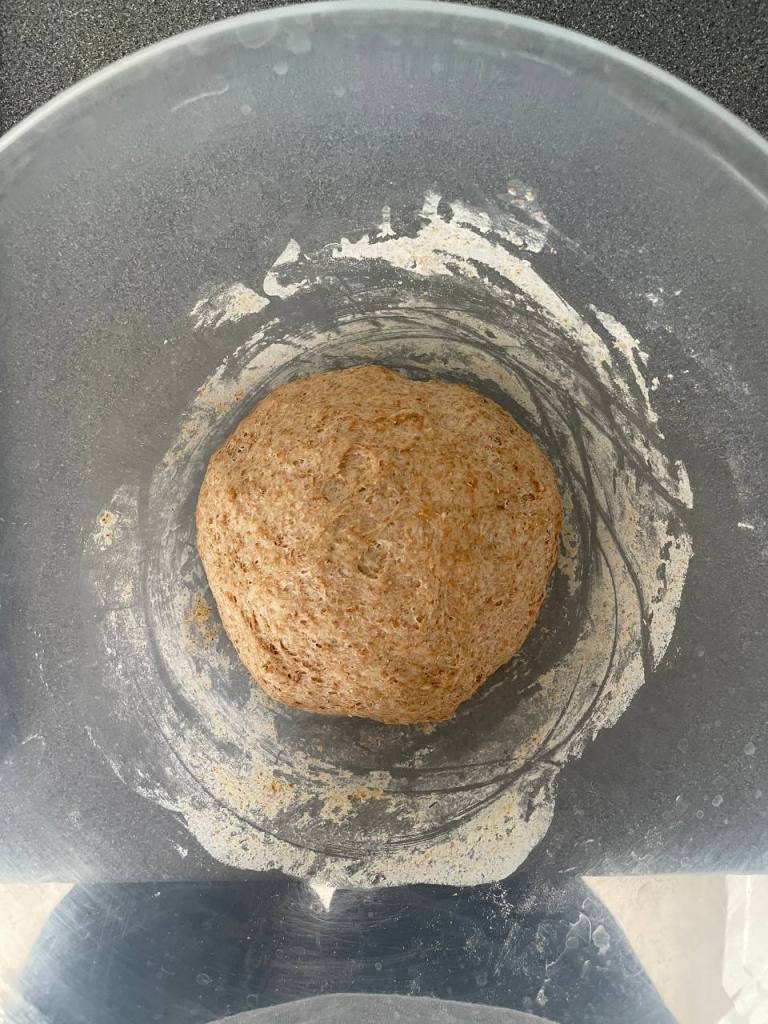
- Cover the dough and let ferment for two and a half hours. In this time, every 45 minutes or so, uncover the dough and use the stretch and fold technique to develop some strength. In this case, I went around the dough in 8 folds.
- After 2.5 hours, your dough should have expanded in size, ideally doubled. If not, then it is likely that you used an over fermented starter, meaning that you have too much bacteria relative to yeast. This will result in a chewier product, but by no means a bad one!
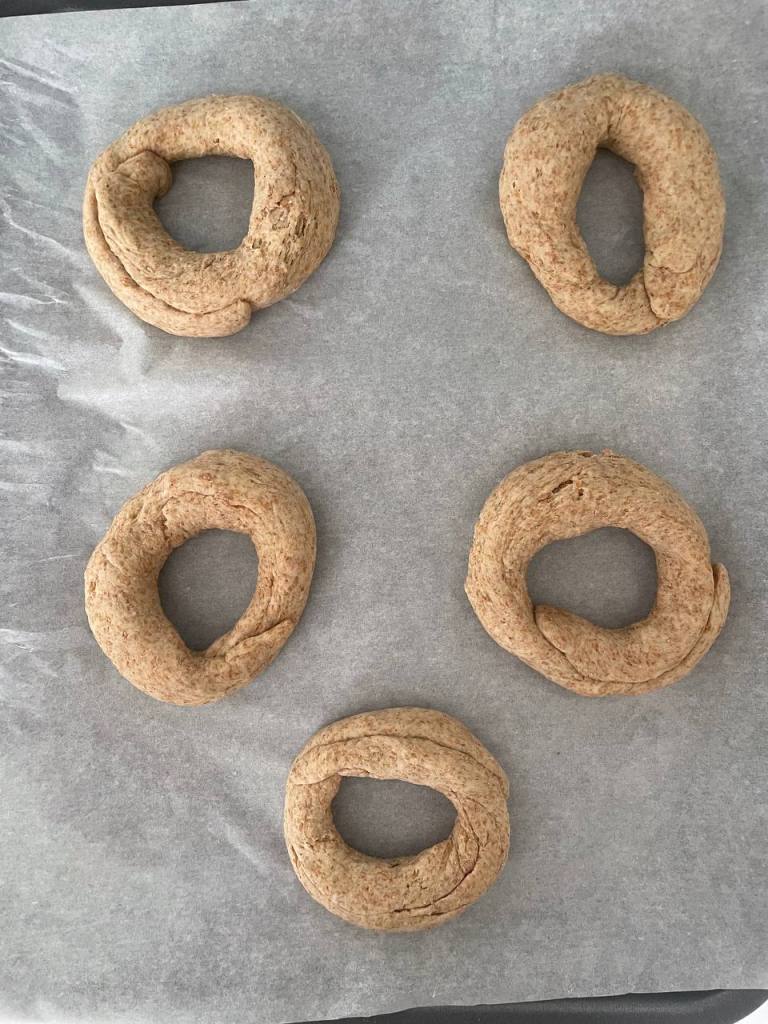
- Now, cut the dough into four. Roll the doughs into logs (around 25 cm), and then wrap each log around your hand before sealing the ends together lightly. Then place on the counter and gently roll the seal against the surface to strengthen it.
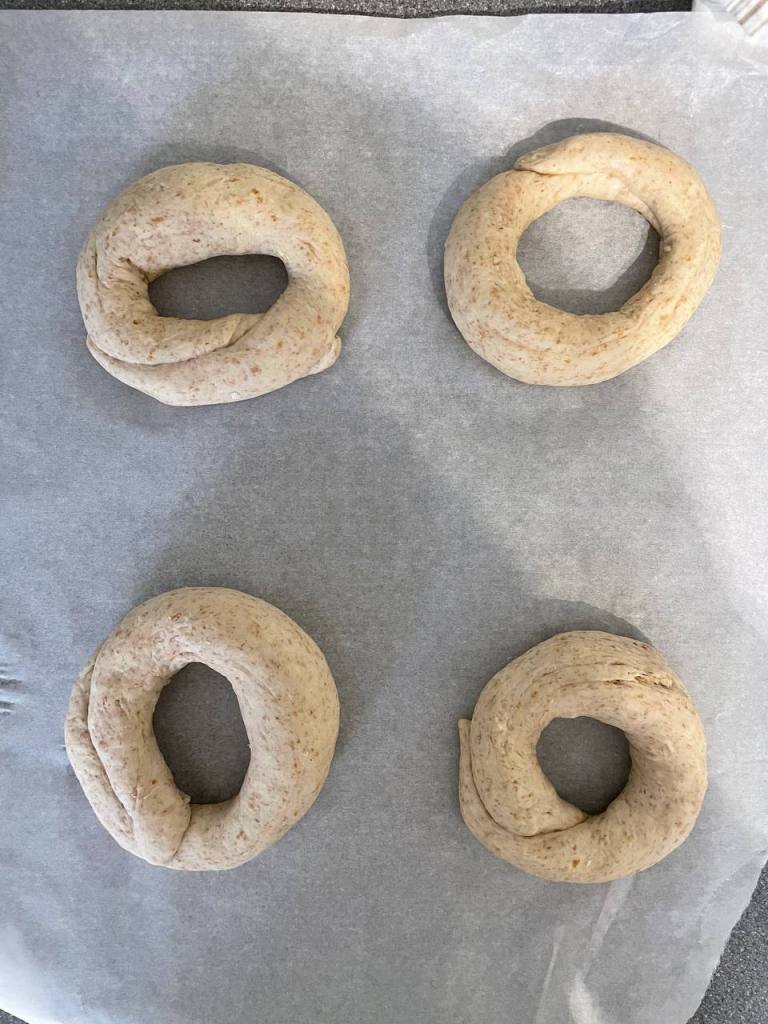
- Proof for around half an hour, or until puffed up (see images below).
- In the meantime, preheat your oven to 250 degrees celsius, and bring a large pot of water to a boil. Add a tablespoon of bicarb into it4. Poach the bagels for 30 seconds on each side, and put them on baking paper. The use of a slotted spoon will be immensely helpful here.
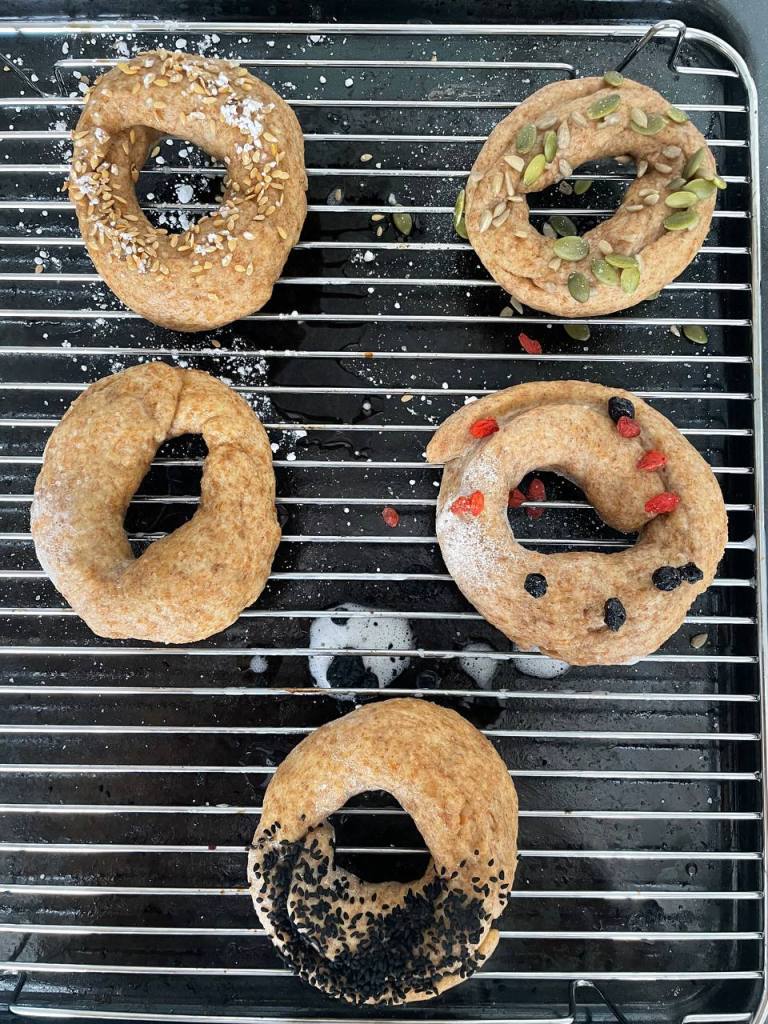
- As the bagels are wet, you can sprinkle them with the toppings of your choice. I like my bagels simple with salt and icing sugar, though this time I tried some funky variants too: nigella seeds, linseeds, short grain rice, mixed porridge grains. I will discuss how these turned out in the next section.
- Bake immediately, for around 15-20 minutes (as per the instructions from e5 Bakehouse, though I found mine didn’t need as long). They are done when they have a beautiful dark brown/golden color on both sides. Be careful with the toppings you choose, as some will burn if the bagels are too close to the radiator, or because they simply cannot handle 250 degrees for more than 5 minutes!

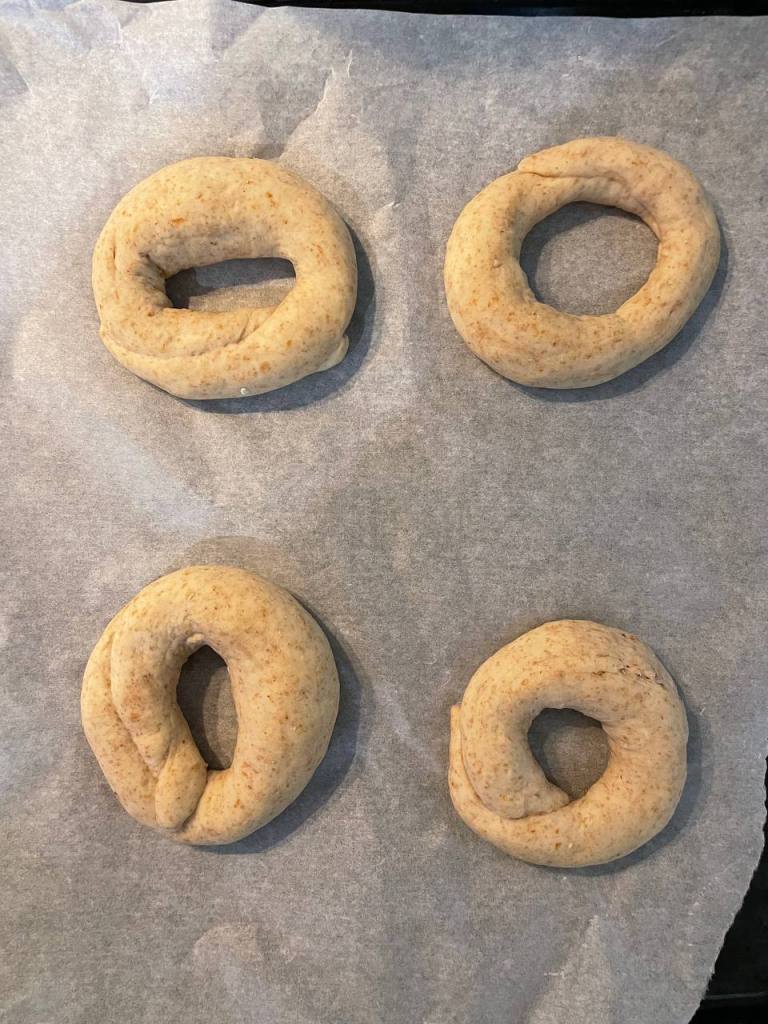
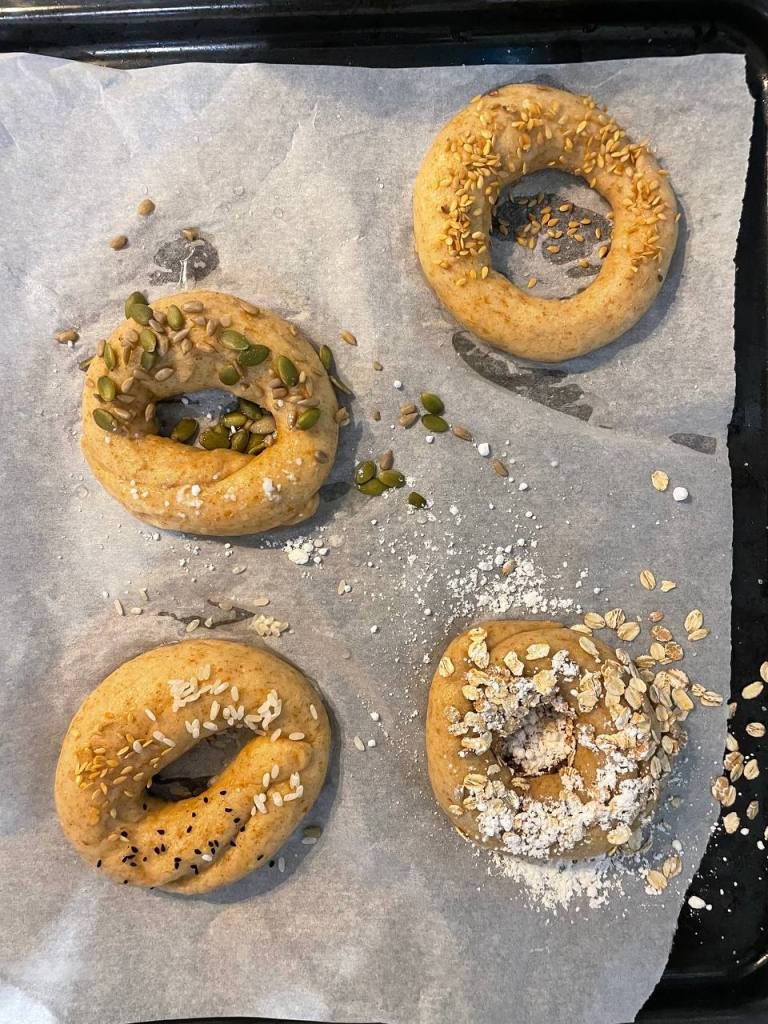
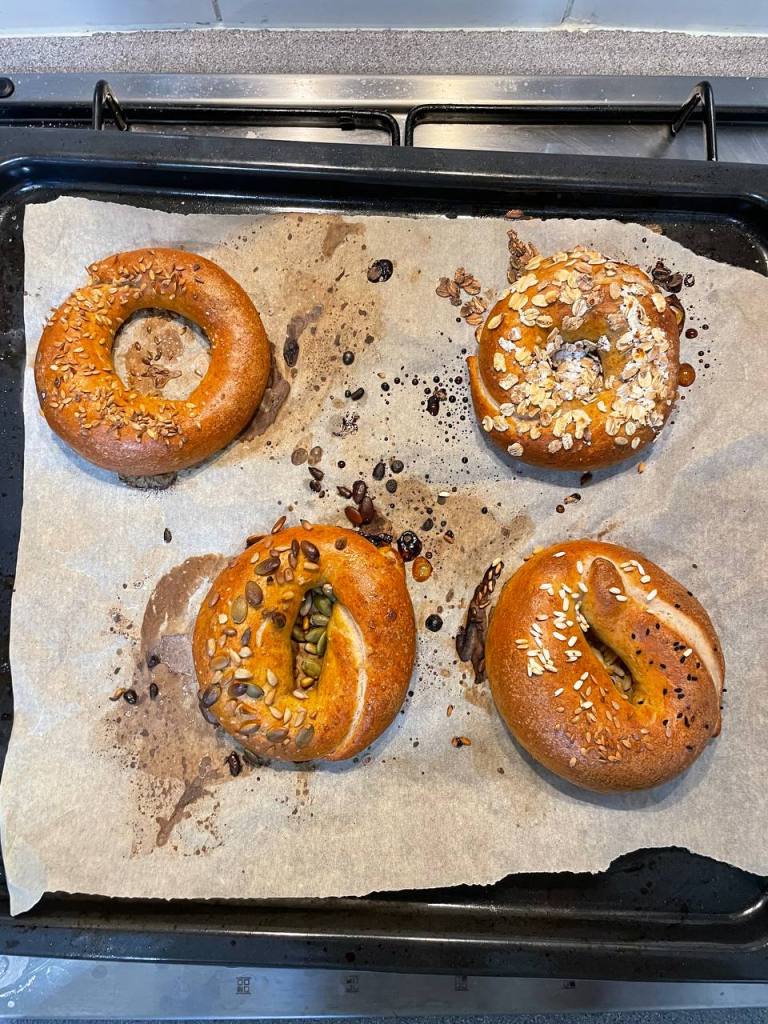
Funky Experiments
As cooking “activates” my brain, I had to try a few funky things and satisfy my curiosity.
Toppings
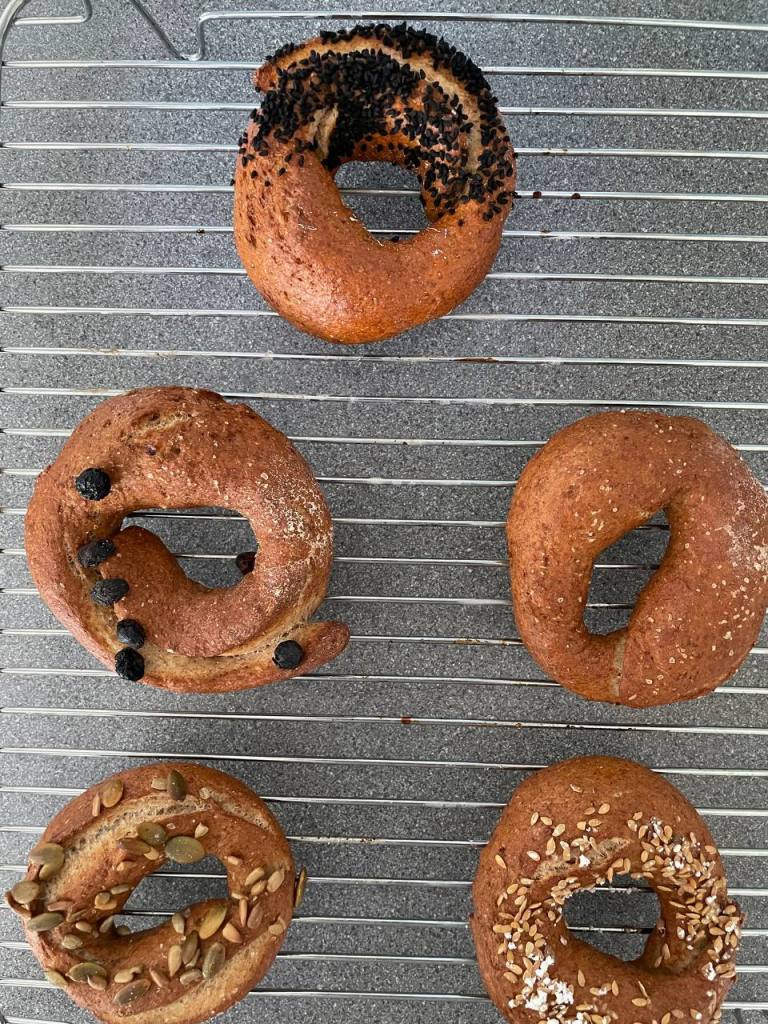
Nigella seeds and linseeds were excellent on choices for the bagels. Part of me feared that they would burn at 250 degrees, but there was no hint of bitterness. The nigella seeds flew the bagels to a different cuisine… they made the bagels taste like a raised bread native to the Middle East or India5! The linseeds are great if you love the flavor of linseeds. The steam from the baking process extracts that “soaked” linseed flavor that you get when you add it to salads or to your overnight oats, but without compromising on the roasted flavor that you get from cooking them.
Some of the other experiments were disasters. I was particularly disappointed by the goji berries/blueberries… these burnt to a crisp! As for rice… I had hoped it would puff up, but it was as hard as it is raw.
The mixed porridge grains turned out ok… I liked them quite a bit but part of me was thinking: I wish I’d added something else instead!
Wholemeal-Semolina Bagels
I’m not sure what I was thinking here… but I wanted bagels again and wasn’t bothered to buy white flour… so I used mostly wholemeal with some semolina added to “see what will happen”. Note: my sourdough starter had also been fed with wholemeal flour.
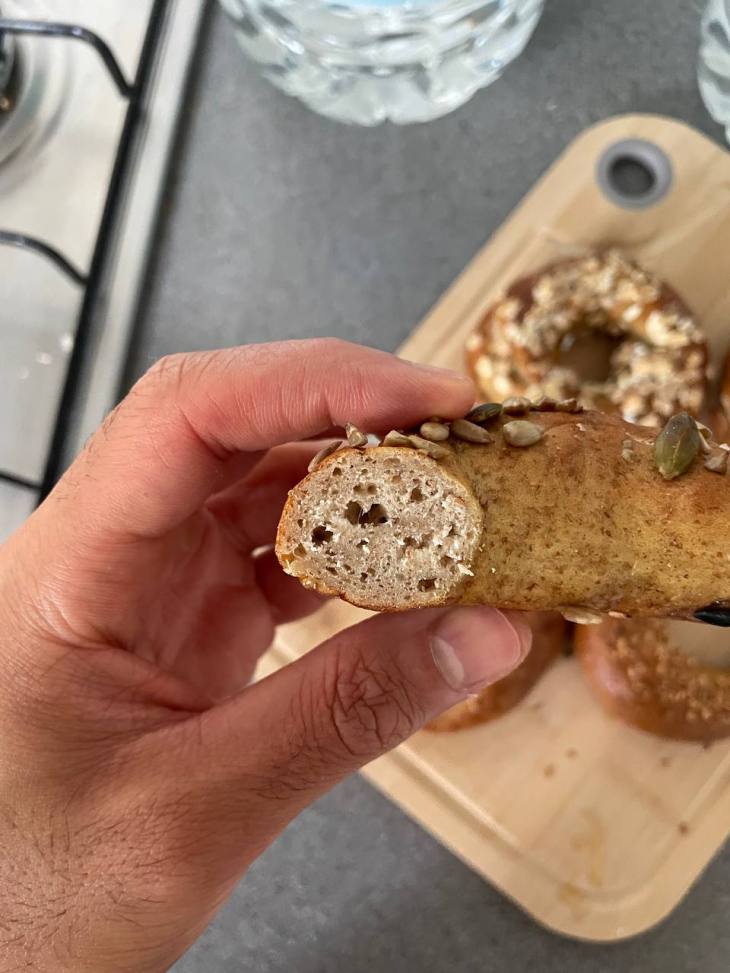
The result was OK: a flavorful bagel, but a bit too earthy from the wholemeal flour. I couldn’t tell if the semolina changed anything. The bagels were almost too chewy, in the same way that wholemeal toast is chewier than white toast. Finally, the bagels were denser because I used an over fermented leaven on purpose to see if I could impart more of a sour flavor..sadly it didn’t provide me with the outcome I desired!

Concluding Remarks
These bagels were seriously good. If you love a flavorful, chewy and beautifully colored bagel then you must make these yourself, as what you find outside won’t satisfy you in the way these do.
The only thing I’m miffed by is that I couldn’t taste the fact that this was sourdough. I’ll need to do some reading to see how I can enhance the flavor of my starter going forwards.
- My sourdough starter ↩︎
- Both Doug and Duke died after I started feeding with wheat 😦 ↩︎
- Keeping it for longer would mean an increase in the bacteria culture relative to the yeast one, so theoretically you would get a stronger “sour” flavor (and it would be better for your gut as the wheat will. pre-digest further), but at the cost of rise! ↩︎
- This is the most important step in my opinion, as it is what will give your bagel that nice, brown color characteristic of lye baking. Some people prefer to add honey, sugar or malt to get browning. I have not tried this myself, but I haven’t seen the other methods get the same color you get as you do when using an alkaline solution. ↩︎
- Flatbreads dominate in these regions! ↩︎

 Tsunami's Hungry
Leave a reply to Shalité Attempt 3 – Sourdough! – Tsunami's Hungry Cancel reply