Ramadan is the 9th month of the Islamic calendar, which is observed by Muslims as a month of increased worship of God, primarily through fasting1. Unlike Lent, which restricts the consumption of certain types of food, Sawm (Islamic fasting) requires abstinence from all food, drink, sexual activity and drugs (including smoking and vaping) from dawn to sunset. Breaking the fast at sunset is called Iftar.
Since the UAE is a Muslim country, society adapts to Ramadan: work hours are reduced2, families break their fast together, and shops and restaurants stay open till early in the morning (with many restaurants offering pre-dawn meals at 3am!).
I’ve spent many a Ramadan in Dubai, but this time I collected multiple worthwhile experiences which I wish to share with you, through the food that I ate of course.
I’ve split this journey into 3 parts: Family, Fraternity and Forbidden Fruit. This is part 1 of that journey: Family.
Flying to Dubai
My food journey begins with a tiring flight to Dubai, with their flagship carrier, Emirates. I immediately felt the spirit of Ramadan… by accident! It so happened that I had a packed dinner with me, but I intended to have it for lunch instead. So I asked the flight attendants if it was possible to bring me the lunch provided by Emirates for dinner instead. Confused by this request, they thought that I was fasting! It turns out that Emirates provides a special meal at Iftar time3 for those fasting. While my curiosity nudged me to go along with their assumption to see what’s presented with the Iftar meal, my difficulty with being dishonest won and I asked them to store my packed food in the fridge, so that I could have it for dinner instead.
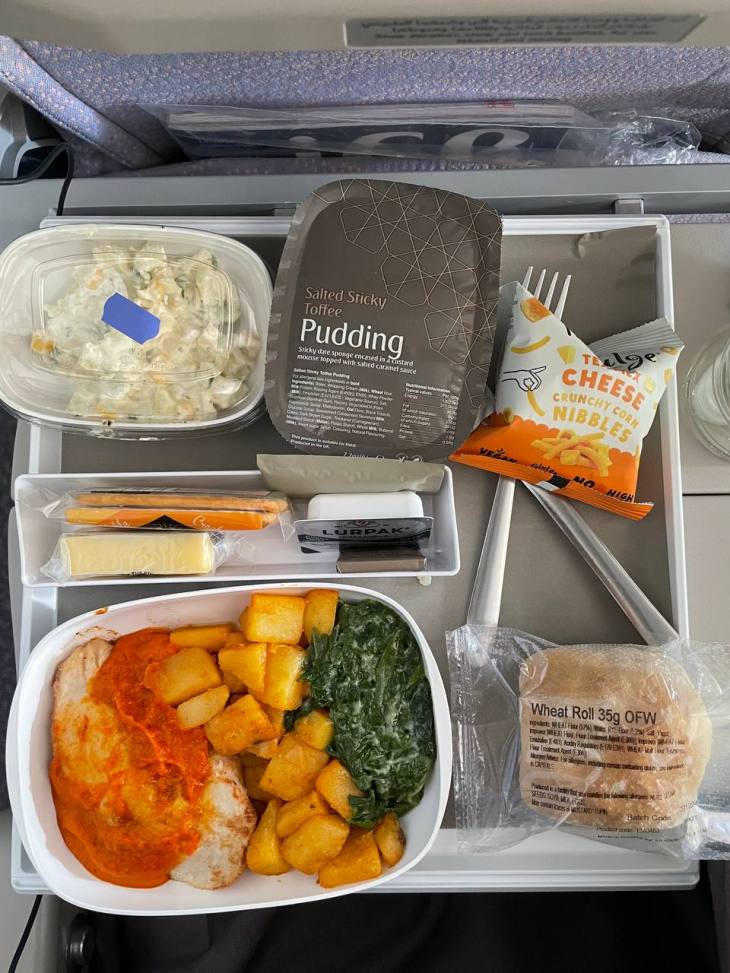
The choices for lunch were: chicken breast with romescu sauce served with creamy spinach and roast potatoes, or lamb rogan josh with rice. Since I’m a sucker for romescu I went for the former. All meals are served with a potato salad (which had too much mayo for my liking), a sticky toffee pudding (which I was dying to try, but I had promised myself to eat healthy this trip), and snacks: a piece of chocolate, a bread roll, butter, cheese nibbles and cheddar cheese.
I really enjoyed the main. The chicken breast was (eerily) not dry, the sauce was tasty and the sides were way above my expectations: the potatoes were coated with a potent tomato sauce and the creamy spinach had a nice texture that I kept going back to between having the potatoes and the chicken.
This meal was a pleasant start to my food journey.
Family: the Iftar Table
The food that my family makes is amazing, which is why I prefer to eat at home whenever I’m back in Dubai. But during Ramadan, it is extra special because at almost every meal we have food items that we tend not to have so regularly normally:
- Fried appetizers, typically samosas, spring rolls and pakoras4 (and sometimes, cheese rolls coated with honey and pistachios!)
- Evazi lamb stew (Khoresht Evaz) that we pour over ripped up bread (usually Gapok)
- Dates (and during Ramadan, everyone gets the best quality dates that they can find)
- A tangy yoghurt drink known as doogh (or laban in Arabic)
- Copious amounts of sugary foods and dessert (of which you’ll find none here since I was determined to eat healthy…!)
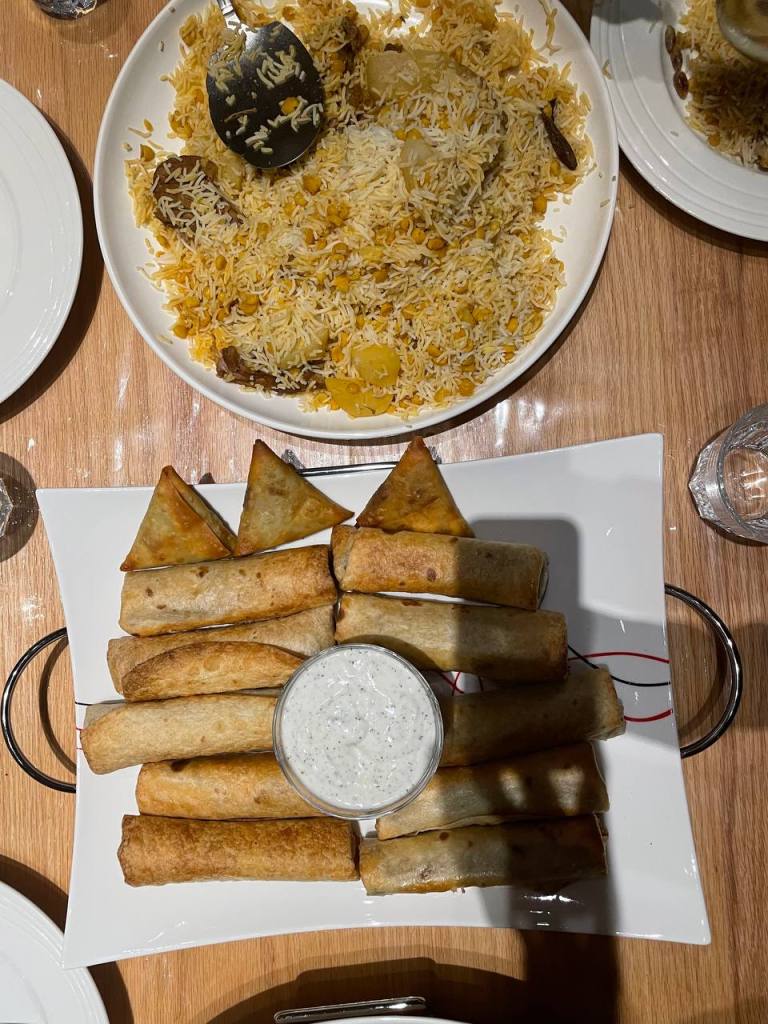
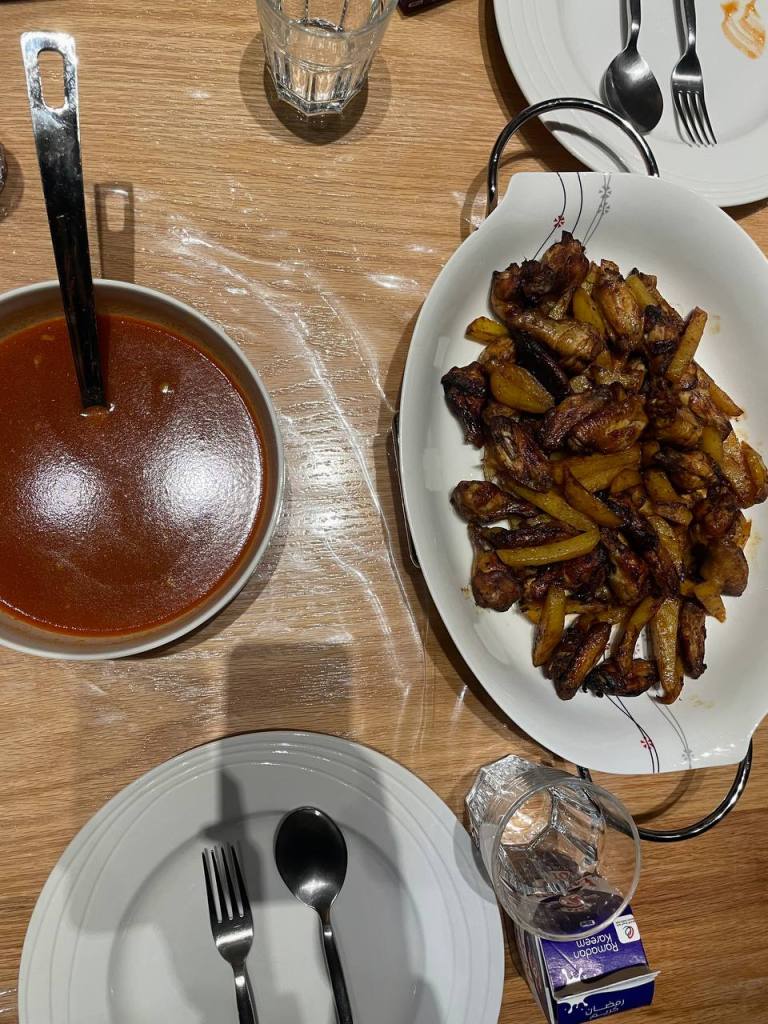
Pay close attention to the photos I’ve put in this article, as you’ll be able to spot the bits and pieces that I’ve described above.
What’s more, you normally get an extra dish on the table from your neighbors or friends, as is custom.
Iftar at my Aunt’s
My first Iftar was at my aunts. I didn’t manage to get a photo of everything, but the Iftar table had homemade Makaroni, deep-fried and oven-fried samosas and spring rolls, roasted white sweet potato, pakoras, Evazi lamb stew, Evazi shrimp stew (qatok maigeh), two types of bread, a mango salad, and a shrimp and bean tahchin from my aunt’s friend5.
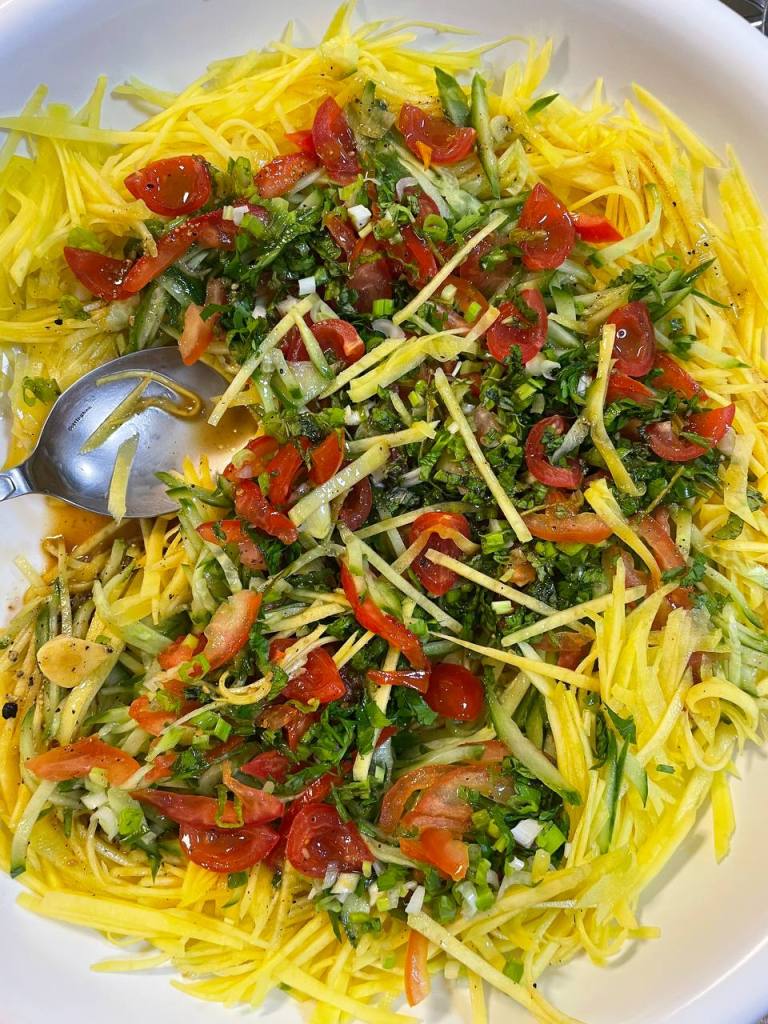
The highlight of the meal for me was the sweet potato as I really enjoy that basic, but comfort, flavor. I devoured the makaroni and had a bit of the lamb stew as well. Both excellent. The mango salad was a nice surprise6: the mangoes were purposely chosen for the fact that they weren’t fully ripe yet, which allowed them to be shredded as shown below. This, paired with the tomatoes, fresh leaves and a tangy sauce made me keep going for more.
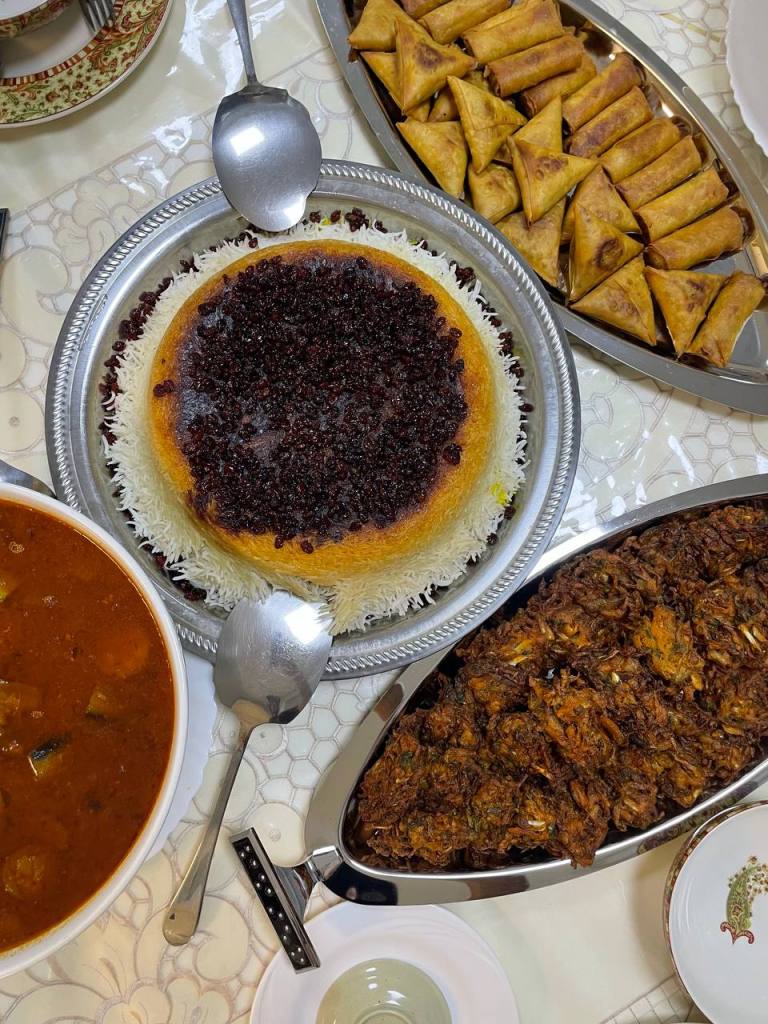
You would be right in observing that this is a lot of food. Luckily, whatever food remains is given out to those in need (at least in my aunt’s household), but I would share your reservation about making such a vast array of different dishes, and in such quantity. You’ll see soon that in some households, like mine, we prepare less distinct dishes and in lower quantities (though it pains me to say that we still have a culture of making new food everyday, even if some remains from the day before). I will revisit this theme in parts 2 and 3 in more detail.
Post-Prayer Food
Those who are observing Ramadan will usually also pray all the five prayers expected of Muslims, but also additional ones that start around an hour after Iftar. These prayers are called Taraweeh.
The typical schedule for an observing Muslim after Iftar is as follows:
- Break your fast at Iftar with a few dates and water
- Pray maghrib (sunset prayer)
- Come back to the Iftar table for a big meal
- Relax for 30 minutes to an hour before going to the mosque to pray Taraweeh, which usually lasts an hour
Once the prayers are done, families usually spend the evenings together. This is also the time when you’d normally go to see your friends if you have plans with them (note that this is around 9 pm! It would be unthinkable to go out at this time in most countries if you have work at 9 the next day).
From this time onwards till around 12 or 1 am, it is also normal to have guests come over. So households will have fruits, confectionary, Iranian tea, and Arabic coffee presented in the living room for anyone to indulge in. If the guests stay till later, such as 12 or 1, then they are usually presented with some food. This is normally in the scale of a dinner, and does not necessarily act as a replacement for suhoor (pre-dawn meal).
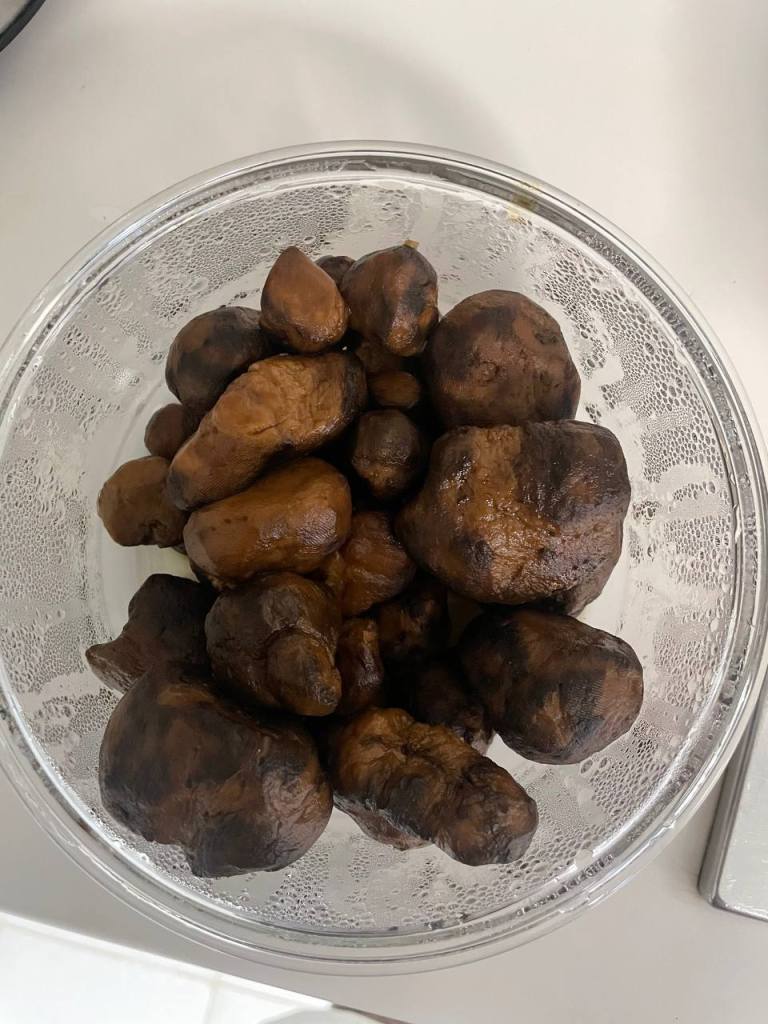
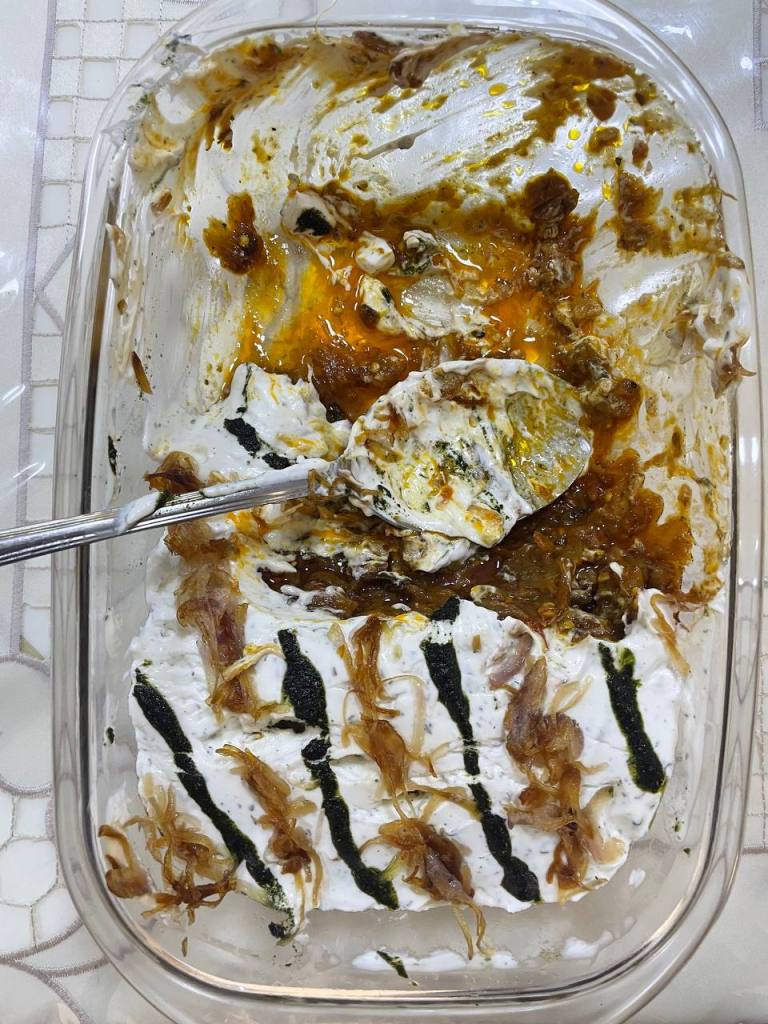
At my aunt’s, I had desert truffles, kashk-o-badenjoon and Zak. They were all excellent. It had been so long since I’d had those truffles so was delighted to have them again. The kashk-o-badenjoon was actually a bit of a fake: the base had tomatoes and they had used labneh instead of whey for the coating on top. However, the flavor was so good that I completely forgive them for desecrating the tradition.
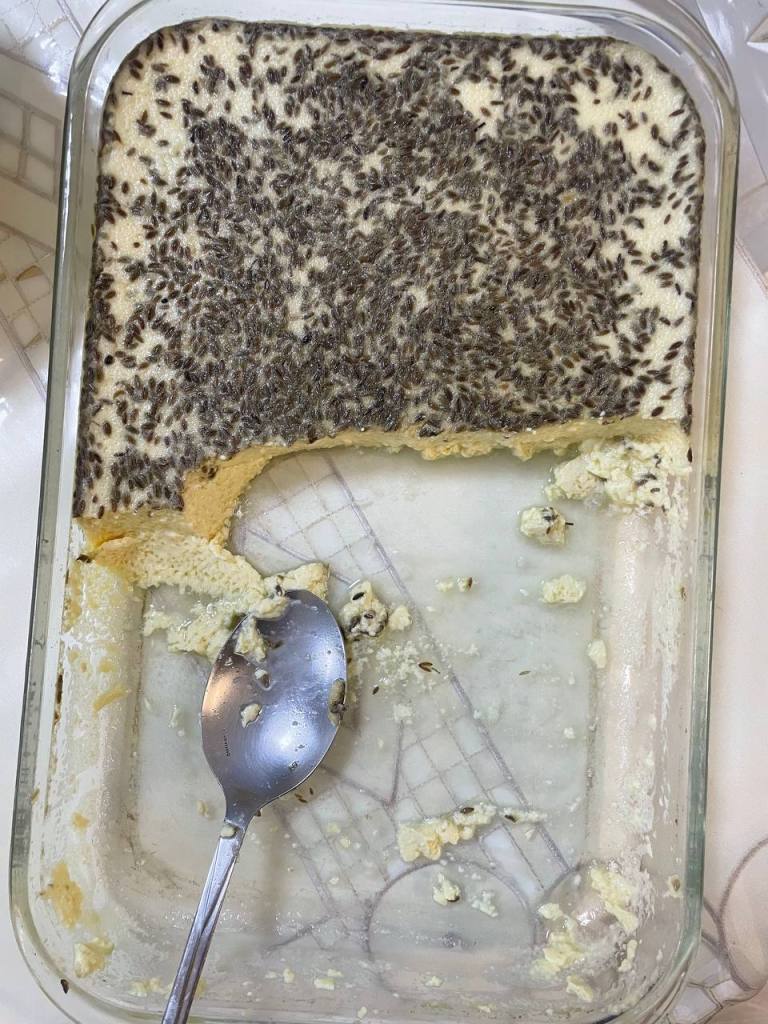
The zak was from a different household. It failed to impress the older generations: complaints of it being to be too sweet (lacking salt) and tasting too much of cumin (it’s practically black!) were far too common. I on the other hand thoroughly enjoyed it, as I covered it with date syrup left from a bowl of lougheymat.
Iftar at my Home
Finally, I need to talk about the Iftar at my home. I really enjoyed this trip as I got to spend good time with my family. Normally, my dad is busy with work so I rarely get to see him on my visits, but Ramadan hours meant that he finished work at two. He actually contributed lots to the food that you’ll see below, so credit where credit is due.
I’ve decided to put pictures of two Iftars: one prepared by my father, and one by my mother, showing the differences in how they view cooking7. I will also be sharing a third, prepared by me, but in its own separate post. There you’ll see the influence of both my parents in my cooking.
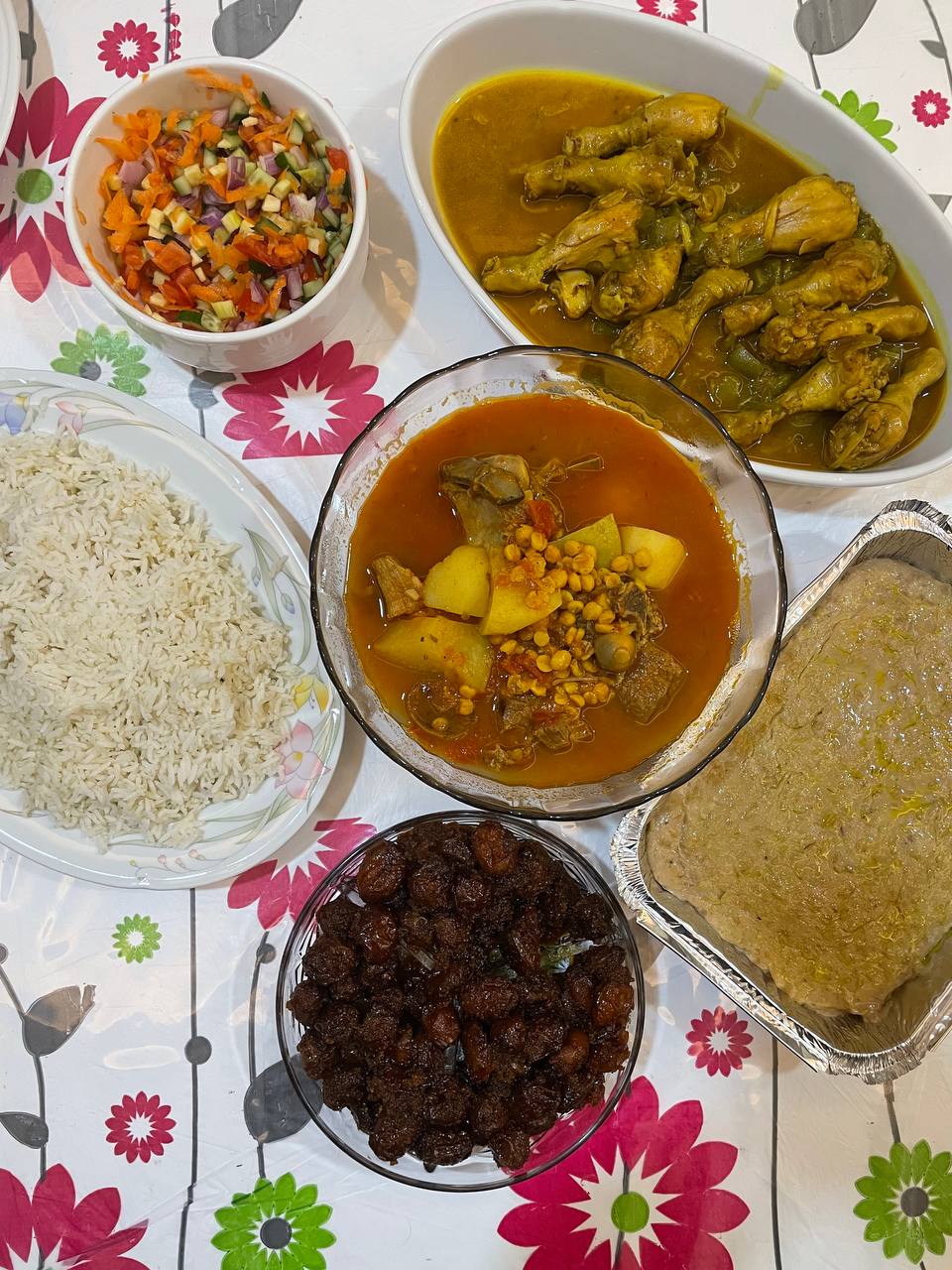
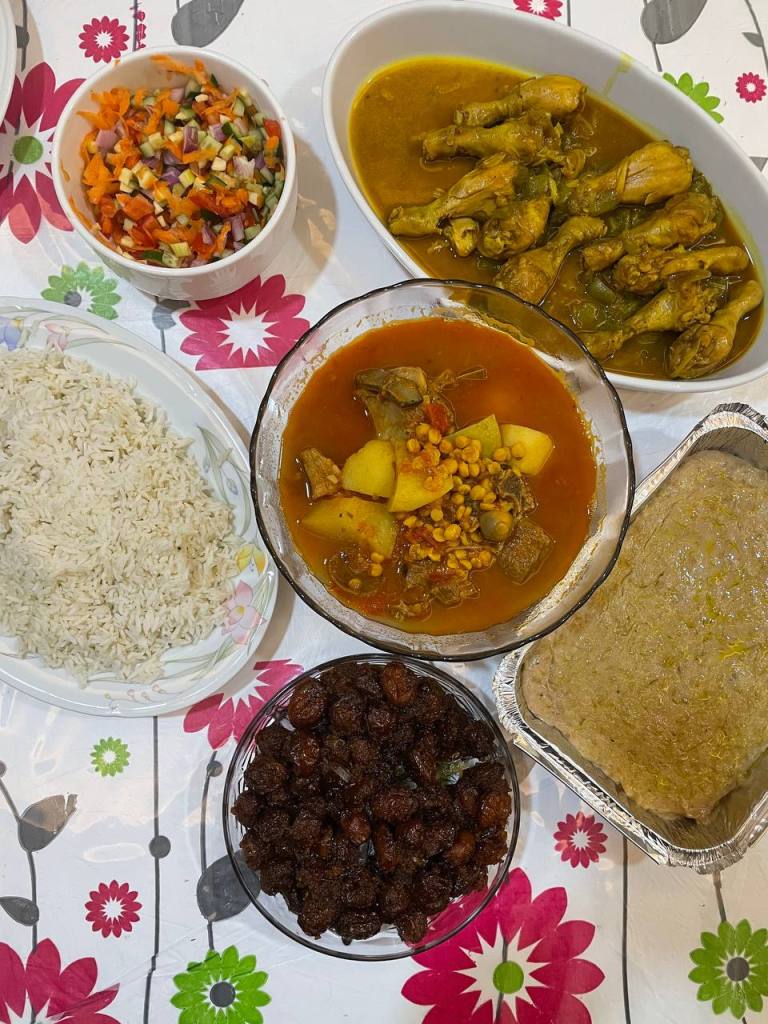
My father is very experimental with food, but he also respects tradition. The Iftar meal he prepared for us is a perfect example of that: the centre of the dish is the Evazi lamb stew, which he himself has with ripped up gapok. This is the traditional element.
The rest of the meal had things he invented, literally 30 minutes before Iftar. He recognized the quantity of food he’d prepared was not enough, so quickly put together a tangy, aromatic and addictive chicken dish8 with a fresh salad (in which he used raw courgettes, something I’ve rarely seen home-cooks other than myself do).
We were gifted harees by our neighbor, which I was delighted by as it was a childhood favorite of mine, usually only served in Ramadan.
My mum’s Iftar was more grand, and designed to impress (to which I’ve done NO justice with the subpar photos I’ve taken…). She decided to make lamb shank slow cooked with rice (which we call au-kaf-nada, literally translating to: that which has been put in between), served of course with the broth from the meat. In addition, she made samosas and spring rolls with a yoghurt and herb dip, and chicken wings using her addictive recipe.
Family is Paramount
I’ll end this post with the following: whether you are Muslim (observant or non-observant) or non-Muslim, I hope that this journey that of mine has prompted you to reflect deeply about your family. It is one of the most important aspects of our lives, and it may not always be the easiest part, but it is inseparable to who we are.
In the next post (which you can now find here), I will take you through the second part of this food journey: Fraternity.
- While Ramadan is mostly synonymous with fasting (to Muslims and non-Muslims alike), the core idea is closeness to God, which includes increased reflection, reading of religious scripture and stories, giving back to the community and thinking of those who have less. ↩︎
- This is typically the case for white-collar jobs only. ↩︎
- This is based on the location the plane is flying over. ↩︎
- While these food items did not originate in Iran or the UAE, they have become quintessential items to serve for Iftar. They differ greatly in flavor, shape and texture to what you’d find in Indian or Pakistani restaurants, as the fillings are heavily influenced by Gulf cuisine. ↩︎
- And this is all I remember… there may have been 1-2 more dishes that have slipped my memory. ↩︎
- You’ll notice that vegetable seem to… disappear in Ramadan. ↩︎
- I’ve described this in more in my first post on this blog! ↩︎
- My brother, whose sole incentive to go back to Dubai is to revisit all the fast food restaurants he had as a kid, asked my dad for the recipe. That’s how good it was. ↩︎


 Tsunami's Hungry
Leave a reply to 🇦🇪 Ramadan in Dubai Part 2: Fraternity – Tsunami's Hungry Cancel reply