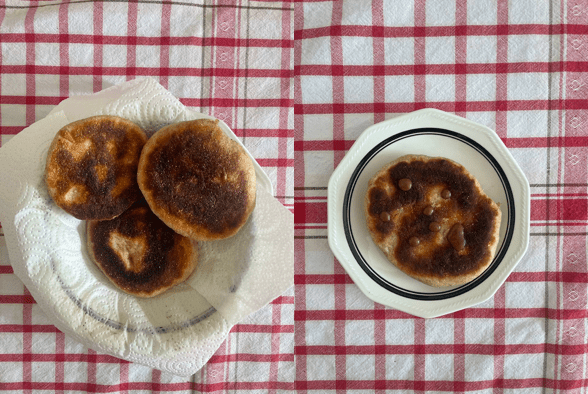
One of my favorite childhood delicacies is Shalité, which is a kind of fluffy round bread with a soft texture and a rich flavor. This bread is Iranian, but as far as I am aware it is only known in southern Iran, and perhaps only within a close proximity to Evaz, the village where my parents originally come from.
Given that it is a localized dish, it should come as no surprise that I struggled to find recipes for this online. Besides, I want to learn how to make it exactly how my family makes it, before I can experiment with it myself.
Typically we have it with Mahweh, which is fermented anchovy paste. I know, it sounds disgusting, but don’t knock it till you try it. Anyways, since Mahveh is so hard to come by, I use shalité as I would use any other bread… for example it pairs excellently with peanut butter, sliced banana and cinnamon!
So how do we make it? Here is where the challenges begin.
The only person I know who knows how to make this is my aunt, and my data-centric personality was keen to have access to her recipe… only to realize (admittedly, I should have always known) that there is no physical recipe for it. These recipes are all passed from generation to generation through practice, not even through word of mouth.
So… I tried to extract it from my aunt anyways, and here’s what she told me:
Ingredients
- 1000 g wheat flour (number 2 or number 3)
- 1 tbsp sugar
- just under 1 tbsp salt (assuming that you’re planning to add Mahveh afterwards, which is salty)
- 1 tbsp yeast
- Between 1.5-2 cups of water (or until the mixture doesn’t stick to your fingers)
Instructions
- Add the dry ingredients to a bowl and mix
- Add the water
- Mix until you have a non-sticky ball
- Place in a bowl and let rise
- Split the dough into tangerine sized balls, and flatten them into a disk shape
- Cover again and let rise
- Fry in the pan (but don’t deep fry)
My Attempt
Naturally not everything in the instructions is clear. Mainly the choice of flour: I’ve only seen type 2 or type 3 flours in Dubai, and I’m not exactly sure what combinations of soft/plain/wholemeal flour I need to use to recreate something similar!
So for my first attempt, I decided to replicate what I thought type 2 flour would be, by mixing 50% of Type 405 flour1 and 50% of wholemeal flour.
Since I wasn’t going to make a massive batch I went for a total of 200 g of flour. I scaled the ingredients by mass (this is tricky if you don’t have an accurate scale… I’m fairly certain I had more yeast and sugar than I was planning!).
I wasn’t clear on how long I had to wait, so I just waited for the dough to roughly double in size.
Once flattened, I added some rice flour on top to prevent the shalité’s from sticking. Although this had some interesting ramifications on the flavor.
It was finally time to cook them!
Outcome
Overall, the shalité’s turned out good. However, they were still really far from the actual thing. I’d say I got to (at best) 60% of the way. Here are some differences I noticed with my shalité’s compared to my aunt’s:
- My shalité surface was quite hard. I attribute this to the fact that I set the heat too high and thus burnt the surface
- The burnt surface affected the flavor… a lot. The inside of was really good, but overpowered by the browned and burnt surface
- It felt a bit too “bready”. I think this will be the hardest to perfect since it’s to do with the flour. Shalité has a really subtle taste where it has the texture of bread, but not quite the taste of a bread that you’re used to. If I’d closed my eyes and taken a bite, I would have thought it’s just bread, not shalité. I’m thinking that next time I’ll do 110:90 grams soft:wholemeal flour, I’ll add a bit more sugar and let it rise slightly more
- The rice flour didn’t change the flavor (or at least I didn’t notice it), but I think it contributed to a hard outer texture and accelerated the burning. Next time I’ll choose a more suitable container to let the dough rise so I don’t have to bother with rice flour to prevent stickiness
Some tips if trying to reproduce
Make sure to add enough oil. My health conscious self was thinking that I can just have a thin layer… you need enough to cover a bit of the tapered sides of the shalité dough disk, without having too much that it becomes a semi-deep fry. A later of 2-3 mm should be enough imo.
When you put it in the dough will puff up. I’m still not sure when is the best time to flip it, but I think with some more attempts I’ll get a better idea.
Be sure to get the pan and oil hot really hot, but lower the temperature as soon as you put your shalité’s in to prevent burning. Make sure to let the shalité rest for a bit after it is out of the pan, otherwise the surface is too hard.
- Type 405 flour is a type of flour found in Germany. This is roughly equivalent to soft white flour ↩︎

 Tsunami's Hungry
Leave a reply to Getting to Know Dusty – Adventures in Rye – Tsunami's Hungry Cancel reply