Ramadan is the 9th month of the Islamic calendar, which is observed by Muslims as a month of increased worship of God, primarily through fasting1. Unlike Lent, which restricts the consumption of certain types of food, Sawm (Islamic fasting) requires abstinence from all food, drink, sexual activity and drugs (including smoking and vaping) from dawn to sunset. Breaking the fast at sunset is called Iftar.
During this month, there is an increased sense of community, involvement in charity and understanding of the struggle of others.
I’ve spent many a Ramadan in Dubai, but this time I collected multiple worthwhile experiences which I wish to share with you, through the food that I ate of course.
I’ve split this journey into 3 parts: Family, Fraternity and Forbidden Fruit. This is part 2 of that journey: Fraternity. I’ve written the post such that you can read it without having read part 1, but if you’re interested to, then you can find it here.
Fraternity: Giving Back to the Community
One of my favorite things about Ramadan is that there is an increase in programs to help people in need, with a secondary effect of fostering community. The most obvious example that I can think of is through the mosque: free meals are provided for Iftar, and sometimes even Suhoor (pre-dawn meal). In Europe2, it is possible to eat free food at the mosque regardless of your religious or ethnic background3, and in this way, the mosque acts as a substitute for the failing welfare systems under late stage capitalism, helping the public dealing with food insecurity and the cost of living crisis4. Below is a video going through the process of preparing Iftar for 30000 people at Abu Dhabi’s Grand Mosque, the scale of which is quite astonishing:
Beyond the mosque though, food related charity increases greatly during Ramadan. This can take many forms, from Muslim countries increasing food related aid that they provide to countries with food shortage issues, to programs within a country to provide food for the most vulnerable. On the former, I recall participating in a charity event organized by the UAE’s second telecom operator, Du (whom we’ll get back to soon), packing cartons of food to be shipped to Ethiopia (if my memory serves me correctly).
However, not only is there more of an appetite for charity and giving during Ramadan, it is also the case that individual food donations and charity increase. In Islam, fasting is mandatory except for cases where it is difficult to fast (such as illness, being on your period, travel5, etc…). If someone skips their fast, then they are required to pay to a charity that uses that money to feed people (this is known as fidya). While it is fair to argue that this system incentivizes those who have the means to pay to break their fast, while simultaneously punishing those in financial need, the net effect is that in Ramadan, more money is individually given to charities whose sole purpose is feeding people.
There is also a dark side to the increase in food donations during Ramadan. Those who are financially well off almost always end up with a massive amount of leftovers at Iftar. The silver lining is that the families that don’t waste this food give the food to people in need – however, the better attitude would be to only consume what one needs, as food is a limited resource that many do not have.
Dubai Traffic
Dubai is notorious amongst locals for its traffic, and since cars remain the most convenient method of transport6, no matter how many lanes on the road, there is still traffic.
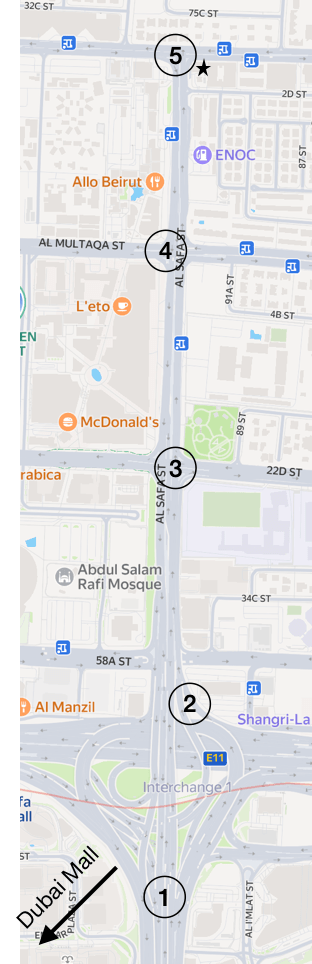
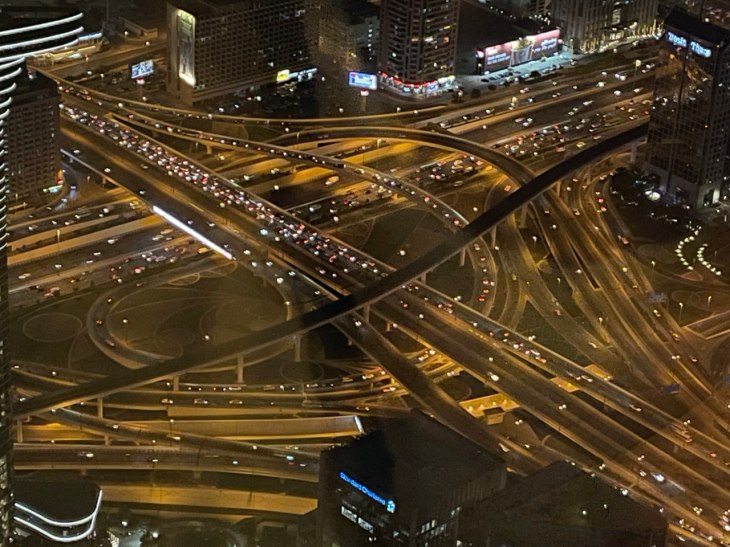
While far from being the worst example of traffic in Dubai, I find the congestion on Al Safa Street to be particularly stressful. The issue starts when you’re coming down from the bridge overlooking the Dubai Mall (point 1 on the map). This lane is going at speeds of 100 km/h (if there is no traffic), and it suddenly converges with the two lanes coming in from the left (point 2 on the map), from Interchange 1 (‘The Abomination’ is a more apt name I find). Those coming from the left want to go right, and many of those coming from the Dubai Mall bridge want to go left. This, paired with the traffic light at point 3 in the map, causes a massive jam.
Once you cross the junction, you’ll notice that just before the junction at point 4, many of the cars are trying to change from the priority lane to the right. The map is misleading: there are 4 lanes not 2. So everyone who stayed in the priority lane to avoid the jam at the previous junction at point 3 wants to switch three lanes to to right, inevitably causing another jam before the junction.
Buckle up as things get even more stressful. At this point, drivers wanting to get to the last junction (point 5 on the map) are completely fed up. The moment the lights at point 4 turn green, they rush to make it to the other side. The problem? There is insufficient flow of cars before the junction at point 5 turns red again, so it is not uncommon to see cars stuck in the box junction7 just after point 4, blocking the flow of traffic on Al Multaqa street.
You’d hope that the problem eases after this point, but no: The vast majority of cars getting to point 5 want to go left, not right. There’s always a jam on the left 2 lanes, with the right lane completely free. So you’ll see a lot of smart-asses getting right to the junction through the right lane, and then cutting into the middle lane!
If the above sounds bad in normal circumstances, just imagine what it’s like with everyone rushing back from work to make it home before Iftar…. sleep deprived from their outing the night before, hungry from fasting, angry from life, work and the other drivers around them.
Luckily for us, the spirit of Ramadan comes to alleviate some of the stress.
Breaking the Fast on a Traffic ‘Break’
The star shown on the map, near point 5 is the location of a long-standing 24 hour pharmacy called Life Pharmacy. For as long as I can remember8, Life Pharmacy works either alone, or in cooperation with Du, to hand out small parcels to the drivers stuck at the junction at point 5 near Iftar, so that they can break their fast if they don’t manage to get home on time. These parcels contain the basic foods that are traditionally had at the start of Iftar: dates, water, laban (salty yoghurt drink) and usually a light bite (something starchy, such as a sandwich or biscuits).
I’ve copied over a link from their Instagram below, showing some photos from their handout last year:
I can’t say how it must feel to be given this after a long day of hard work, and a grueling battle with traffic all while fasting, as I’ve never had that experience. I do recall the joy of receiving such parcels as a kid in the back seat with my mum driving though, and I would posit that the drivers getting those parcels must be infinitely more touched.
This is the type of charity that may not have material impact: the food provided here is not enough for a full meal, and does not act as a food program feeding the hungry. But the psychological effect it has on people has to be respected and acknowledged.
A Shared Understanding of Struggle
The shared understanding of the struggle of fasting among Muslims is beautiful thing.
I’ve had many an experience at restaurants where the food comes a bit later than Iftar, and could truly feel the pain felt by the waiters who bring the food late through their deep apologies. They themselves would have been fasting and working with food the whole day, but never did they show a smidgeon of their hunger.
I was lucky to witness another beautiful event this trip. As I was driving out of Dubai Mall just before Iftar, I saw a bunch of cab drivers standing together next to a few parcels of food that they’d (presumably) ordered from outside, ready to eat together. Under normal circumstances, I’d hardly imagine them sharing a meal together, as they’d be stressed about finding customers to take home. The shared struggle of fasting brought them together to share a meal, fostering community.
I was fasting in neither of the experiences above, which brings me to the final experience, where I was also not fasting.
This was, truly, one of the tastiest meals I’ve had in my life. Under normal circumstances, I’d probably have judged it as any other dish, but the context is what made it so special. In the Ramadan of 2023, I took two of my friends visiting Dubai to do the classic Desert Safari tour. For those unaware, the tour ends with a camp in the desert where you are served food as you watch a few shows (belly dancing, playing with fire, etc…). As they were preparing to serve us food, I enquired about the time when food was to be served (it is shameful to say, but you already know it as this is the name of the blog: I was so hungry and not even fasting 😅). The guy looked at me, profiled me, and asked if I were fasting. Out of shame, hunger and surprise I responded yes, thinking that we were going to get food earlier than the rest.
The guy, deeply apologetic for not having known this, immediately went and got me water, dates, and the rice dish that him and his colleagues (all of whom were fasting) were having. It was a humble vegetarian dish: rice cooked with spices and served with a few dates, but each bite made me fall in love with life again until I fell in love with love itself. The food served to everyone else at the camp, including my friends, could never compare.
Packing Food for Iftar
The final food experience I wish to share as part of this post is the packing of food to give out – to neighbors, strangers and those in need.
One of our neighbors organizes this every Ramadan: they order copious amounts of harees and biryani in massive aluminum pots, and people come to his home to help pack it into aluminum parcels to be sent out. This is the first time I participated in this activity.

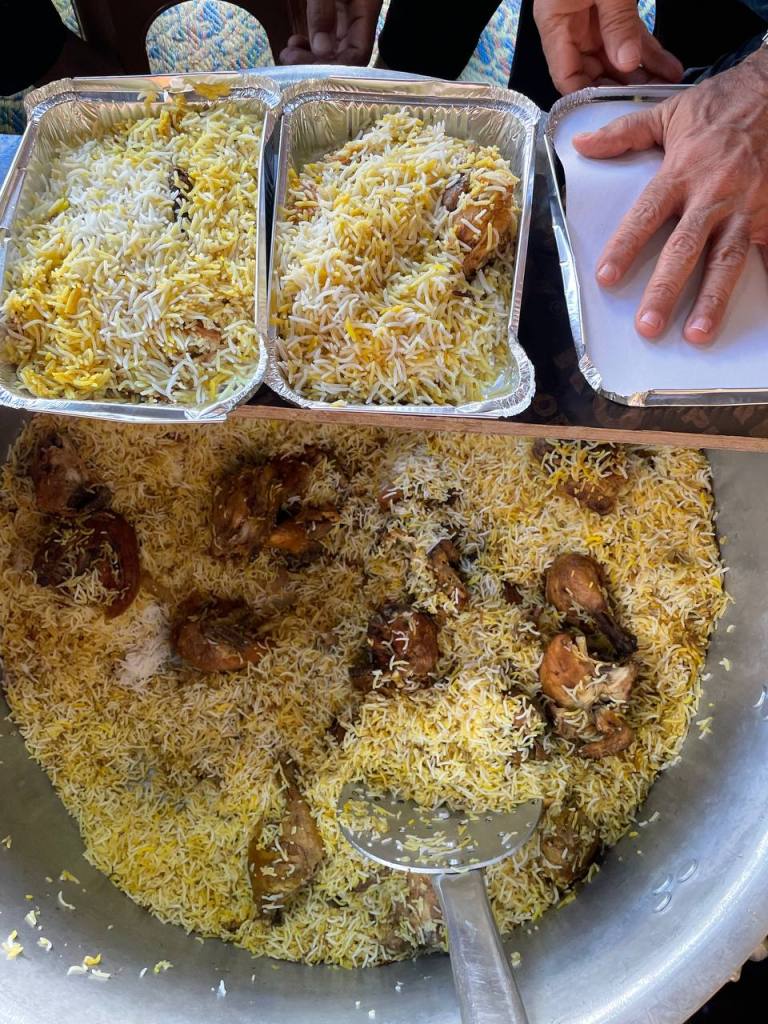
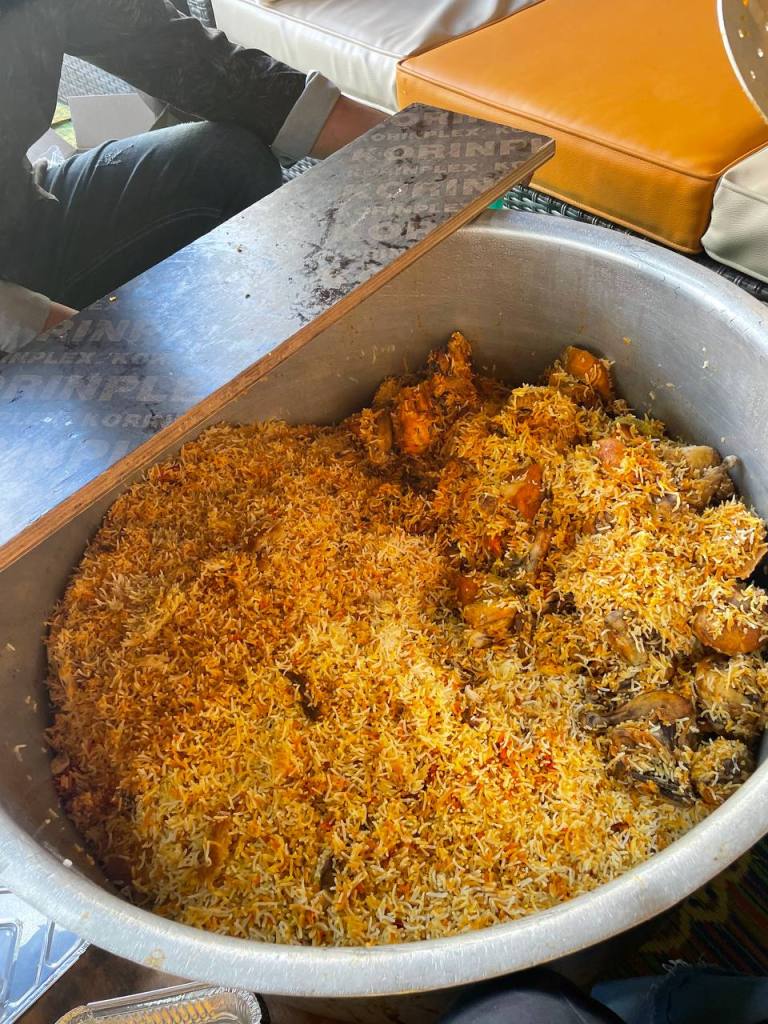
It is hard to say exactly how many parcels of food we helped pack, but I would estimate the number to be around 500. It was an enriching experiencing for sure, as I saw people of high and low economic class working together to prepare these parcels (a collaboration that has historically been rare). We also contributed to packing food bags containing water, dates, an apple, and biscuits, to be handed out to people stuck in traffic exactly as is done by Life Pharmacy and Du. It would have been amazing to be part of the team handing these out to those stuck in traffic, but I did not have the opportunity to do this.
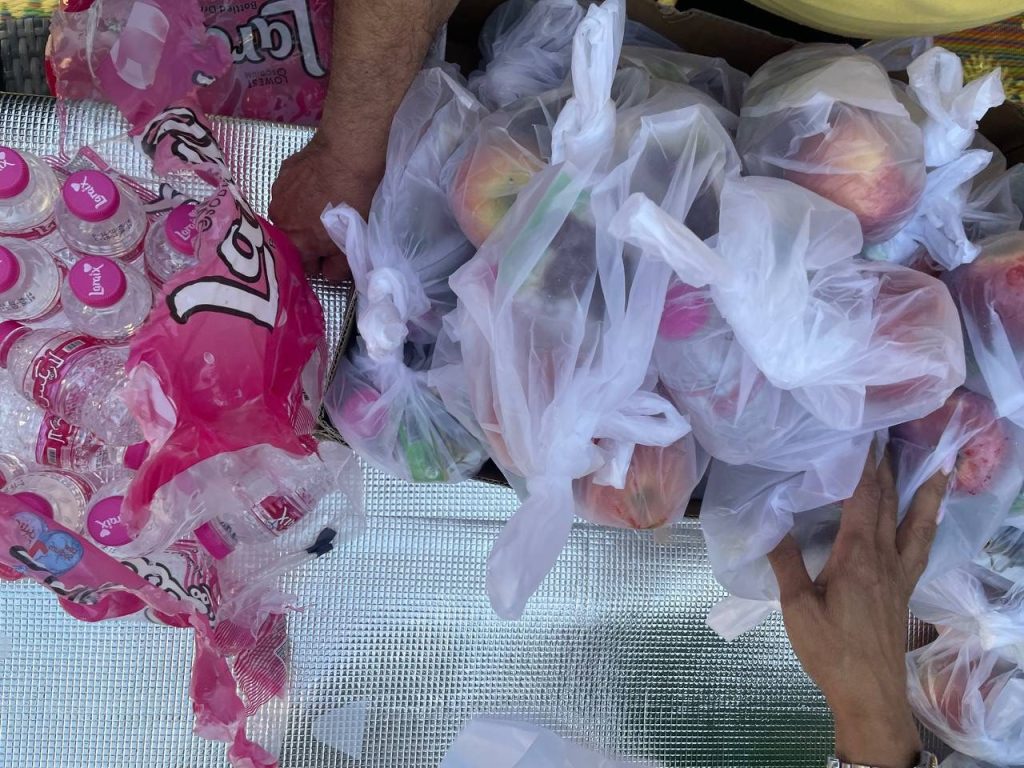
While the experience was great, the big question for me was, and remains: what actually happens to this food? I got to learn that this food was not going just to those in need, but that a good amount of it was going to neighbors (who would be firmly in the high class of society). It does make me wonder: the organizer gives out the same food every day for the entirety of Ramadan… surely a wealthy family receiving this would not consume it every day? Do they all then give it out to those in need? How much of it gets wasted? Why not just cut the middle man and give directly to those in need?
Further, being part of the process gave me more insight into how these mass food operations work. The emphasis is on packing as much food, as quickly as possible, so it is possible for food of subpar quality to sneak into some of the packages9.
But that said, criticizing is easy, making the commitment to invest into this project, every year, is not. If I were doing this myself, there is little that I’d change save for directing the food to a food bank (or a mosque), where it is given to everyone present, but will likely be consumed only by those in need.
I do hope that some of those food bags brought the same joy that I got as a kid, receiving a parcel from Life Pharmacy, to the kids of those drivers stuck in traffic.
Free Fair Food
I’ll end this post with the following: whether you are Muslim (observant or non-observant) or non-Muslim, I hope that this journey that of mine has prompted you to reflect deeply about the privileges that you have grown up with. If you are reading this, it is likely that you’ve never (or rarely) suffered from food insecurity or scarcity. We live in a world abundant in resources for everyone – the problem is that we don’t distribute it to those who need them the most. Consume only the amount that you need, and always try to help those who are hungry.
In the next post, I will take you through the third and final part of this food journey: Forbidden Fruit.
- While Ramadan is mostly synonymous with fasting (to Muslims and non-Muslims alike), the core idea is closeness to God, which includes increased reflection, reading of religious scripture and stories, giving back to the community and thinking of those who have less. ↩︎
- While I imagine this is possible everywhere, I have not seen evidence of this so reluctant to make such a claim. ↩︎
- I know this first hand from a white atheist who visited their local mosque every day of Ramadan for free food to save money as a student. ↩︎
- This is not a strictly Muslim idea. Churches, Gurdwaras and the like have always supplementing food banks for feeding homeless people and people facing food insecurity. ↩︎
- Though with the increase in availability of food options in destination countries due to globalization century a lot of people choose to fast while traveling. ↩︎
- Dubai does have a bus system, but the same journey by bus can take 4 times as long compared to taking it by car. The rail system is a paltry single line with no branching. There are major works planned to expand it by 2040 (which I’m very much looking forward to). ↩︎
- I’ve been stuck in this myself… and worse, I remember the rage of my parents when they got stuck there from my early childhood. ↩︎
- I would estimate this to be 18 years. ↩︎
- Some of the apples had started to grow some fuzz. Overall though, there was only 1 rotten apple out of 6 cartons. ↩︎

 Tsunami's Hungry
Leave a comment